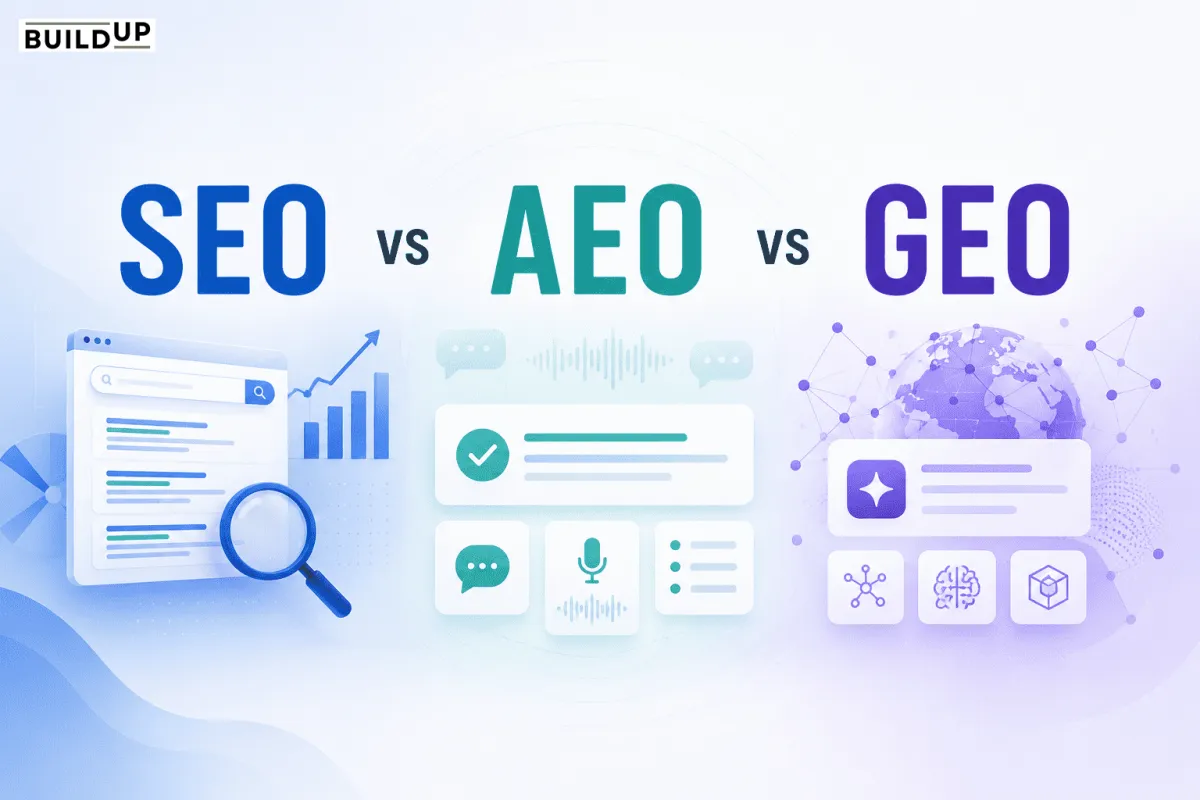
SEO vs AEO vs GEO: Understanding the New Search Landscape
SEO (Search Engine Optimization) improves your rankings in traditional search results. AEO (Answer Engine Optimization) positions your content to appear in AI-generated answers and featured snippets. GEO (Generative Engine Optimization), sometimes called generative AI optimization, focuses on getting your brand cited in large language model responses, such as those from ChatGPT, Perplexity, and Google's AI Overviews. Each discipline targets a different part of the modern search funnel, and the most effective digital marketing strategies use all three.
Key Takeaways
SEO, AEO, and GEO are distinct disciplines targeting different parts of the search landscape: rankings, direct answers, and AI-generated responses, respectively.
Traditional SEO remains essential; it's the foundation on which AEO and GEO are built.
Answer Engine Optimization uses structured data, schema markup, and intent-aligned formatting to win featured snippets and voice results.
Generative Engine Optimization focuses on entity authority, content comprehensiveness, and citation-worthy claims to appear in AI-generated answers.
Integrating all three creates a compounding visibility advantage that no single-channel strategy can match.
Search has changed faster in the last three years than in the previous decade. Businesses that once relied on a handful of keyword rankings now face a fragmented discovery landscape, one where answers surface before websites, AI overviews replace blue links, and local intent shapes nearly every query.
To compete, marketers need to understand not just SEO, but two newer disciplines alongside it: AEO and GEO.
What Is SEO vs AEO vs GEO? The Core Differences
Understanding the difference between SEO, AEO, and GEO starts with recognizing where users encounter your brand in the first place.
Search Engine Optimization (SEO)
Is the practice of improving a website's visibility in traditional, organic search engine results pages (SERPs). Core SEO levers include keyword research and on-page optimization, technical site health (crawlability, Core Web Vitals, indexability), and authority-building through backlinks and E-E-A-T signals: Experience, Expertise, Authoritativeness, and Trustworthiness.
Target: Search rankings
Primary Signal: Backlinks, keyword optimization, and on-page SEO
Content Format: Web pages, blog posts, landing pages
User Touchpoint: Traditional search engine results pages (SERPs)
Answer Engine Optimization (AEO)
Merged alongside the rise of voice search and featured snippets. Rather than optimizing for ranking position, AEO optimizes for being the answer, surfacing content inside answer boxes, People Also Ask panels, and voice assistant responses. AEO relies heavily on structured data markup, concise question-and-answer formatting, and aligning content with the specific intent behind a query.
Target: Featured answers and direct responses
Primary Signal: Structured data, search intent, and question-based content
Content Format: FAQs, schema markup, featured snippets, and concise answers
User Touchpoint: Answer boxes, voice search, and AI summaries
Generative Engine Optimization (GEO)
Also referred to as AI SEO or AI content optimization, it is the newest of the three. It focuses on making your brand, content, and expertise citable by AI systems. When a user asks ChatGPT, Gemini, or Perplexity a question, those models pull from indexed content to build responses. GEO is about ensuring your content is authoritative, well-structured, and semantically rich enough to be included in those generated answers.
Target: AI-generated responses
Primary Signal: Entity authority, citations, and topical expertise
Content Format: Comprehensive, well-cited, and authoritative content
User Touchpoint: AI platforms such as ChatGPT, Perplexity, and AI Overviews
How Traditional SEO Still Drives Organic Visibility

Despite the noise around AI and answer engines, traditional search engine optimization remains the foundation of any sustainable digital marketing strategy. Google still processes billions of queries daily, and the majority of commercial searches still result in users clicking through to websites.
Effective SEO in 2024 and beyond requires more than keyword placement. Google's ranking systems now evaluate:
Topical authority — Does your site comprehensively cover a subject area, or does it address a single keyword in isolation? Sites that build content clusters around core topics tend to outrank thin, isolated pages.
E-E-A-T signals — Google's Search Quality Rater Guidelines reward content that demonstrates first-hand experience, verifiable expertise, authoritative sourcing, and trustworthiness. This means author bylines, credentials, original data, and transparent editorial standards matter.
Technical SEO fundamentals — Site speed, mobile usability, structured URL architecture, and proper crawl management remain critical. A well-written page that takes five seconds to load will consistently underperform a well-optimized one.
User behavior signals — Click-through rate, dwell time, and low bounce rates signal relevance to Google's systems. Content that genuinely satisfies search intent naturally performs better on these metrics.
For service businesses especially, local SEO remains a high-value channel. Optimizing Google Business Profile, earning citations from local directories, and building geo-relevant content are still among the highest-ROI tactics available.
What Is Answer Engine Optimization and Why Does It Matter?
AEO is the practice of structuring content to be selected as the direct answer to a user's query. As search engines evolved to understand intent rather than just keywords, the way results are displayed shifted as well. Featured snippets, knowledge panels, People Also Ask dropdowns, and voice assistant responses all represent "answer engine" behavior where the search engine itself becomes the destination, not just a signpost.
To optimize for answer engines, content must be:
Intent-matched — The four primary search intent types are informational, navigational, transactional, and commercial. AEO typically targets informational and commercial queries where users are seeking direct explanations or comparisons.
Semantically structured — Headers should mirror natural question phrasing. Answers should follow immediately beneath the question, in 40–60 words, before expanding into detail. This "inverted pyramid" structure aligns with how featured snippets pull content.
Marked up with schema — Schema.org structured data signals to search engines what your content is and who it is for. Key schema types for service businesses include FAQPage, HowTo, LocalBusiness, Service, and Review. Proper implementation increases the likelihood of rich results appearing for your content.
Voiced naturally — As voice search continues to grow, optimizing for conversational phrasing is critical. Queries like "what's the difference between SEO and AEO" or "how does answer engine optimization work" reflect how real users speak, not how they type.
AEO is not a replacement for SEO; it's a layer on top of it. Pages that already rank well are more likely to be selected for featured snippets. AEO amplifies existing SEO authority.
What Is Generative Engine Optimization (GEO)?
Generative Engine Optimization is the practice of making your content citable and trustworthy enough to appear in AI-generated responses. It's the newest discipline in this trio, and arguably the one most businesses are least prepared for.
When a user asks an AI assistant a substantive question, the model synthesizes information from sources it has indexed or been trained on. GEO is about ensuring your brand shows up in that synthesis, not as a ranked link, but as a cited source or referenced authority.
Several factors influence AI citation behavior:
Entity recognition — AI systems understand the web through entities: businesses, people, topics, and their relationships. Establishing your brand as a recognized entity through consistent NAP (Name, Address, Phone) data, Wikipedia presence, structured data, and cross-platform mentions increases the likelihood of AI models "knowing" who you are.
Content comprehensiveness — LLMs favor sources that address topics thoroughly. Thin content, duplicate content, and content that avoids taking clear positions tend to be deprioritized in model training and retrieval.
Citation-worthy claims — GEO-optimized content includes statistics, original research, expert commentary, and specific methodologies that AI models have reason to reference. Generic explanations are rarely cited. Specific, sourced, authoritative content often is.
Semantic clarity — Avoid ambiguity. AI models struggle with content that is vague, overly hedged, or structured in ways that make its core claims hard to extract. Clear definitions, direct assertions, and logical content architecture improve both human readability and machine comprehension.
SEO vs AEO vs GEO: How to Integrate All Three

The most effective content marketing strategies don't choose between SEO, AEO, and GEO; they layer all three into a unified approach. Here's how that works in practice:
1. Start with SEO Fundamentals
Research primary and secondary keywords. Build topical authority through content clusters. Earn backlinks from relevant, authoritative sources. Ensure technical site health. This is the base layer that makes everything else possible.
2. Layer in AEO Structure
Once a content strategy is in place, optimize each piece for direct-answer placement. Add FAQ schema, use question-based H2s, include 40–60 word direct answer blocks near the top of long-form content, and align topic coverage with People Also Ask data.
3. Build toward GEO Authority
Establish your brand as a recognized entity in your industry. Create original data, case studies, and expert commentary that give AI systems something worth citing. Maintain consistent brand signals across all platforms; your website, Google Business Profile, LinkedIn, industry directories, and press mentions all contribute to how LLMs perceive your authority.
4. Each Layer Reinforces The Others
A page that ranks well is more likely to earn featured snippets. A page that earns featured snippets is more likely to be indexed and cited by AI systems. The flywheel effect is real, but it requires an intentional strategy across all three disciplines to get it spinning.
Conclusion
SEO, AEO, and GEO are not competing strategies; they are sequential layers of a modern search visibility framework. SEO earns you a seat at the table. AEO positions you as the answer. GEO makes you the source that AI systems trust and cite.
Businesses that treat these as separate initiatives tend to underinvest in all three. The smarter approach is to build them together: solid technical SEO and topical authority as the foundation, intent-aligned content structure for answer engine placement, and entity-rich, citation-worthy content for AI retrieval. Each layer compounds the one beneath it.
The search landscape will keep shifting, AI Overviews will evolve, new retrieval systems will emerge, and user behavior will continue to fragment across platforms. What won't change is the underlying principle: brands that communicate expertise clearly, structure content intelligently, and build genuine authority will win visibility regardless of how search surfaces it. That's what SEO vs AEO vs GEO is really about, not chasing formats, but building a digital presence that earns trust at every layer of the funnel.
Frequently Asked Questions
1. What is the main difference between SEO, AEO, and GEO?
SEO optimizes for search rankings, AEO optimizes to be selected as a direct answer in search results, and GEO optimizes for citation in AI-generated responses like those from ChatGPT or Google's AI Overviews.
2. Does AEO replace SEO?
No. AEO works best on content that already ranks well through SEO. The two disciplines are complementary. SEO earns visibility, AEO converts that visibility into direct answer placement.
3. What is generative engine optimization (GEO)?
GEO is the practice of making your brand and content authoritative enough to be cited by AI language models when they generate answers to user queries. It involves entity optimization, content depth, and citation-worthy claims.
4. What structured data is most important for AEO?
FAQPage, HowTo, LocalBusiness, Service, and Review schema are among the most impactful for service businesses. They signal content type and intent directly to search engines.
5. How do I know if my content is optimized for AI answers?
Test your key topics in ChatGPT, Perplexity, and Google's AI Overviews. If competitors appear and you don't, that's a GEO gap. Improving entity presence, content depth, and structured data typically closes it over time.