
What Is Link Building in SEO? The Foundation of Better Rankings
Link building is the process of acquiring hyperlinks from other websites that point back to your own site. Search engines like Google treat these backlinks as votes of confidence, using them to gauge a website's authority, trustworthiness, and relevance. Strong link building helps a site rank higher in search results, gain visibility in AI-generated answers, and attract qualified traffic that converts into leads.
Key Takeaways
Link building means earning backlinks from other websites to boost authority and rankings
Search engines use backlinks as trust signals when ranking pages
Local link building helps service-based businesses dominate their geographic market
Quality, relevance, and anchor text matter more than the number of links
Structured data and EEAT signals make content more attractive to both search engines and AI tools
What Is Link Building in SEO?
Link building in SEO is the ongoing practice of getting other websites to link to pages on your site. Each of these links, often called backlinks or inbound links, acts as a signal to search engines that your content is valuable enough for another source to reference. The more high-quality, relevant backlinks a website earns, the more authority it tends to build in the eyes of search engines like Google and Bing.
This concept sits at the core of off-page SEO, which refers to ranking factors that happen outside your own website, as opposed to on-page SEO elements like title tags, headers, and content quality. While on-page SEO tells search engines what your page is about, link building tells search engines how trustworthy and important that page is compared to others.
For businesses competing in crowded markets, building links isn't optional. It's one of the primary ways search algorithms differentiate between a credible, established brand and a newer or lower-authority competitor.
How Does Link Building Help SEO?
Understanding how link building helps SEO starts with understanding how search engines evaluate trust. Google's algorithms were built on the foundational idea that links between websites function like citations in academic papers. A page that's frequently cited by other reputable sources is likely to contain valuable information.
When your website earns backlinks from established, relevant sites, several things happen:
Authority increases. Search engines assign a kind of trust score to domains based on the quantity and quality of sites linking to them. More authoritative backlinks generally translate to stronger overall domain authority.
Crawlability improves. Search engine bots discover new pages by following links. A well-linked site gets crawled and indexed faster, which means new content appears in search results sooner.
Referral traffic grows. Beyond SEO value, backlinks placed on relevant, high-traffic sites send real visitors directly to your pages.
Rankings climb for target keywords. Pages with strong, relevant backlink profiles tend to outrank competitors with thinner link profiles, even when on-page content is similar in quality.
AI visibility expands. Large language models and AI Overview features draw on signals similar to traditional search algorithms, including how often a site is referenced and cited across the web. A strong backlink profile can support visibility not just in traditional blue links, but in AI-generated summaries and answers as well.
Key Strategies for Building Links
Effective link building combines several complementary tactics. No single method works in isolation, and the strongest SEO link building campaigns layer multiple approaches over time.
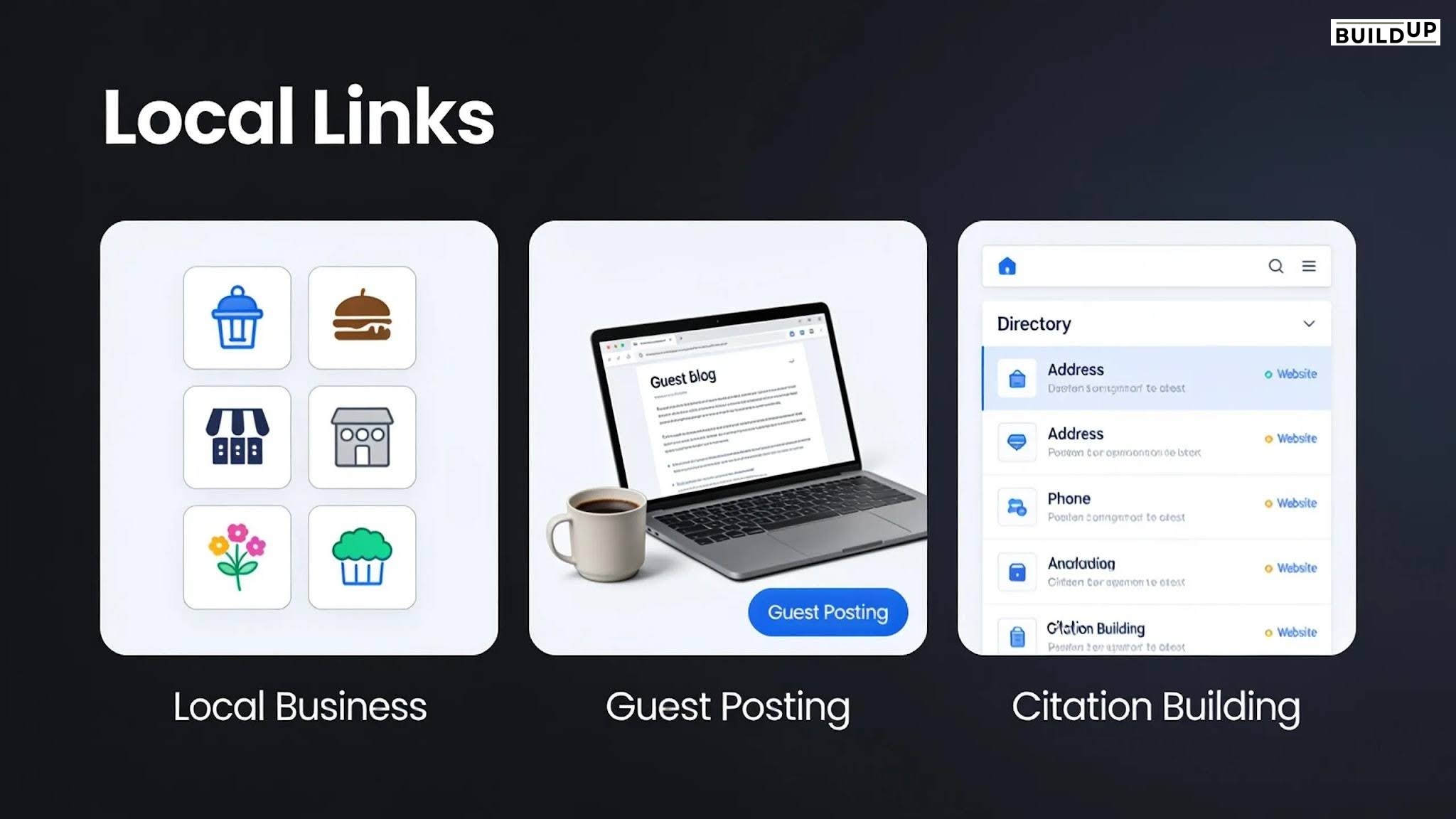
1. Local Link Building
Local link building focuses on earning backlinks from businesses, organizations, and publications within your community or service area. This might include local chambers of commerce, industry associations, sponsorships, or partnerships with complementary local businesses. For service-based companies, local link building reinforces relevance signals that search engines use to connect a business with searchers nearby.
2. Guest Posting
Guest posting involves writing content for other websites or blogs in your industry, typically including a link back to your own site within the author bio or body content. Done well, this strategy builds relationships with industry publications while earning a backlink from a site that already has established authority.
3. Citation Building
Citation building refers to getting your business name, address, and phone number (commonly called NAP data) listed consistently across online directories. While citations aren't always traditional backlinks, they reinforce credibility and, in many cases, include a clickable link back to your website.
4. Digital PR and Outreach
Digital PR involves pitching newsworthy stories, original research, or expert commentary to journalists and publications. When a story gets picked up, it often results in high-authority backlinks from major news outlets, which can significantly boost a domain's trust signals.
5. Resource and Broken Link Building
This technique involves finding broken links on other websites and suggesting your own content as a replacement, or identifying resource pages relevant to your industry and requesting inclusion. It's a mutually beneficial approach: the linking site fixes a broken link, and you earn a relevant backlink.
How to Build Links the Right Way
Knowing how to build links effectively means prioritizing quality and relevance over sheer volume. A single backlink from a respected, topically relevant website often carries more weight than dozens of links from low-quality or unrelated sources.
Create content worth linking to. Original research, in-depth guides, helpful tools, and well-designed visual content naturally attract links because other sites want to reference genuinely useful resources.
Build relationships, not just links. Reaching out to industry peers, local organizations, and relevant publications builds connections that lead to natural link opportunities over time, not just a one-time transaction.
Diversify your anchor text. Anchor text is the clickable wording of a hyperlink. Search engines use anchor text to understand what the linked page is about. A natural backlink profile includes a mix of branded anchors (your company name), exact-match keyword anchors, partial-match anchors, and generic anchors like "click here" or "learn more." Over-optimizing with the same exact-match keyword repeatedly can actually trigger ranking penalties.
Prioritize topical relevance. A backlink from a website in your industry or niche typically carries more SEO value than a link from an unrelated site, even if the unrelated site has higher overall authority.
Avoid manipulative tactics. Buying links in bulk, participating in link farms, or using automated link-building software violates search engine guidelines and can result in manual penalties that are difficult to recover from.
Local vs. National Link Building: A Quick Comparison
Primary Goal
Local Link Building: Strengthens relevance for a specific service area.
National/Broad Link Building: Builds overall domain authority and brand visibility.
Common Sources
Local Link Building: Local directories, chambers of commerce, community sponsorships, and local news websites.
National/Broad Link Building: Industry publications, digital PR campaigns, and guest posts on national or industry-focused blogs.
Best For
Local Link Building: Service-based businesses and brick-and-mortar companies targeting specific geographic areas.
National/Broad Link Building: E-commerce businesses, SaaS companies, and content-driven brands targeting broader audiences.
Typical Link Volume Needed
Local Link Building: Usually requires fewer but highly relevant local links.
National/Broad Link Building: Often requires a larger volume of links from diverse, high-authority websites.
Impact on AI Overview Eligibility
Local Link Building: Reinforces local entity and geographic relevance signals.
National/Broad Link Building: Reinforces topical authority and subject-matter expertise signals.
How Structured Data Supports Link Building and EEAT
Structured data, implemented through schema markup, helps search engines understand exactly what a page is about, who created it, and how it relates to other entities online. While structured data doesn't directly create backlinks, it strengthens the foundation that makes a site more attractive to link to and more likely to be surfaced in AI-generated results.
Schema types like Organization, LocalBusiness, Article, and FAQPage help establish the experience, expertise, authoritativeness, and trustworthiness (EEAT) signals that search engines and AI models increasingly rely on.
A well-structured site with clear authorship, organized content, and properly marked-up data gives both search crawlers and AI systems more confidence in citing that content, which can indirectly support link acquisition by making the site a more credible reference point.
How to Measure Link Building Success
Tracking the right metrics helps determine if link building efforts are paying off:
Referring domains: The number of unique websites linking to your site, which often matters more than total link count
Domain authority or rating: A third-party metric estimating overall site authority based on backlink profile
Organic traffic growth: Increases in non-paid search traffic to pages that have earned new backlinks
Keyword ranking improvements: Movement for target keywords following link acquisition
Referral traffic: Direct visitors arriving through backlink clicks
Conversion impact: Whether traffic from improved rankings and referrals translates into leads or sales
Common Link Building Mistakes to Avoid
Even well-intentioned link building campaigns can backfire when they rely on outdated or risky tactics. Common pitfalls include purchasing links in bulk from low-quality directories, joining private blog networks designed solely to manipulate rankings, using identical exact-match anchor text across every link, and pursuing links from completely unrelated industries with no topical connection.
Search engines have become increasingly sophisticated at identifying these patterns, and the consequences range from devalued links to significant ranking penalties.
A sustainable approach focuses on earning links through genuine value: useful content, real relationships, and a presence that naturally gets referenced by others in your industry and community.
Conclusion
Link building remains one of the most influential factors in how search engines and AI tools evaluate a website's authority and relevance. By combining strategies like local link building, guest posting, citation building, and digital PR, businesses can build a backlink profile that supports stronger rankings, increased visibility, and steady organic growth.
The key is consistency and quality. Rather than chasing quick wins through risky tactics, focus on creating genuinely useful content, building real relationships within your industry and community, and reinforcing your site's credibility with proper structured data and EEAT signals. Over time, these efforts compound, helping your site earn the kind of authority that search engines and AI systems reward with better rankings and greater visibility.
If you're ready to strengthen your link building strategy and build a stronger SEO foundation, The BuildUp Agency can help you create a plan tailored to your business goals.
Frequently Asked Questions
1. What is link building in SEO?
Link building is the process of acquiring backlinks from other websites to increase your site's authority and search rankings.
2. How does link building help SEO?
It signals trust to search engines, improves crawlability, boosts rankings, and increases referral traffic.
3. What's the difference between local link building and general link building?
Local link building targets community-based sources to strengthen geographic relevance, while general link building focuses on broad domain authority.
4. How many backlinks does a site need to rank well?
There's no fixed number; quality and relevance matter far more than quantity.
5. What's the best way to start building links?
Create content worth referencing and build genuine relationships with relevant websites in your industry.