
What is SEO Automation and How It Can Save Hours of Work?
SEO automation is the use of software and AI-driven workflows to handle repetitive search optimization tasks: keyword research, technical audits, reporting, and reputation monitoring without someone manually pulling numbers into a spreadsheet every week. For a small business owner, the ranking checks and citation audits that used to eat an evening now run in the background, and the data lands on a dashboard instead of a to-do list.
Key Takeaways
SEO automation uses software and AI workflows to run repetitive optimization tasks keyword tracking, audits, and reporting - with minimal manual input.
Marketing professionals report saving roughly 10 to 25 hours per week after adopting automated SEO tools, according to industry benchmarks.
Businesses that adopt SEO automation report cutting manual optimization time by up to 60%.
Automation doesn't replace strategy. It clears the busywork so a strategist has time to actually use the data.
At The BuildUp Agency, we build automated reporting and Google Business Profile optimization into the SEO programs we run for Utah service businesses, plumbers, contractors, and fabrication shops among them, so owners spend their time on customers, not on tracking clicks.
What Is SEO Automation? A Practical Definition
Software tools take over the repetitive parts of ranking a website, keyword tracking, site audits, and reporting so an owner isn't managing every ranking factor by hand. That's the short version of what is SEO automation: technology executes the checklist; a person still decides what the checklist should contain. SEO automation accelerates execution. It doesn't set direction.
For a contractor juggling job sites and phone calls, manual optimization eats hours that should go toward billable work. Automated systems close that gap, flagging problems before they cost rankings instead of after.
SEO Automation Does Not Replace a Strategist
Automation handles the heavy lifting on repetitive tasks, but the decisions still need a person behind them. A marketer or agency partner interprets what the data means, sets priorities, and adjusts course as the market shifts. Hand a business the best automation software on the market with no one reading the output, and it will keep optimizing toward a goal nobody set.
A working automated SEO setup usually needs a short list of foundational pieces:
A clear audit of current site performance and local search visibility.
Tools configured to track rankings, technical health, and competitor movement.
A defined content and citation strategy the automation supports.
Ongoing human review to keep automated actions aligned with business goals.
The BuildUp Agency operates out of Draper, Utah, which puts us in the same competitive local-search environment as the clients we serve. That's not incidental; it shapes how we apply automation. Rather than dropping in a generic tool, we build systems to help Utah businesses rank higher, attract more customers, and maintain visibility across both AI-driven search results and traditional Google listings.
Auditing Your Current SEO Tasks
A proper audit starts by listing every recurring search optimization task a business handles, then sorting each one by the result it actually produces. Owners are often surprised by how many marketing hours go toward tracking numbers that never turn into revenue. We've seen agencies chase page views and obscure keyword position metrics that look busy on a report but don't move a phone to ring.
Before starting, pull the last three months of marketing reports, call logs, and website form submissions. These become the baseline for comparison.
List every SEO task performed in the last 90 days, from content updates to citation building.
Sort each task into a "produces leads" column or a "produces vanity data" column.
Cross-reference each task with actual phone calls, form fills, and booked jobs from that period.
Flag tasks that consume time but show no connection to booked revenue.
Rank the remaining tasks by how directly they support long-term growth.
Metrics That Actually Matter in an SEO Audit
Phone calls, form fills, and booked jobs matter more than raw traffic counts. A useful audit tracks those outcomes instead of impressions or keyword position alone; a top ranking means little if it never turns into a scheduled appointment.
Measuring Every Step Builds the Case for Automation
Tracking each step of a marketing plan shows an owner what's working and what isn't. That visibility is the foundation search engine optimization automation gets built on; automating a broken process just makes bad results happen faster. Once the audit separates useful tasks from busywork, automating what's left is the obvious next move. Understanding what is SEO automation starts with knowing which manual tasks are worth automating in the first place.
SEO Tasks to Automate First
Local service businesses tend to see the fastest wins by automating reporting and technical monitoring before touching content or outreach. Contractors, home service providers, and other local businesses need systems built around attracting high-intent local customers, not scattered tactics that drain hours without moving the needle.
Before automating anything, confirm a baseline exists: current rankings, call volume, and lead sources tracked in one place. Skip that step, and there's no way to measure if search engine optimization automation is actually improving results.
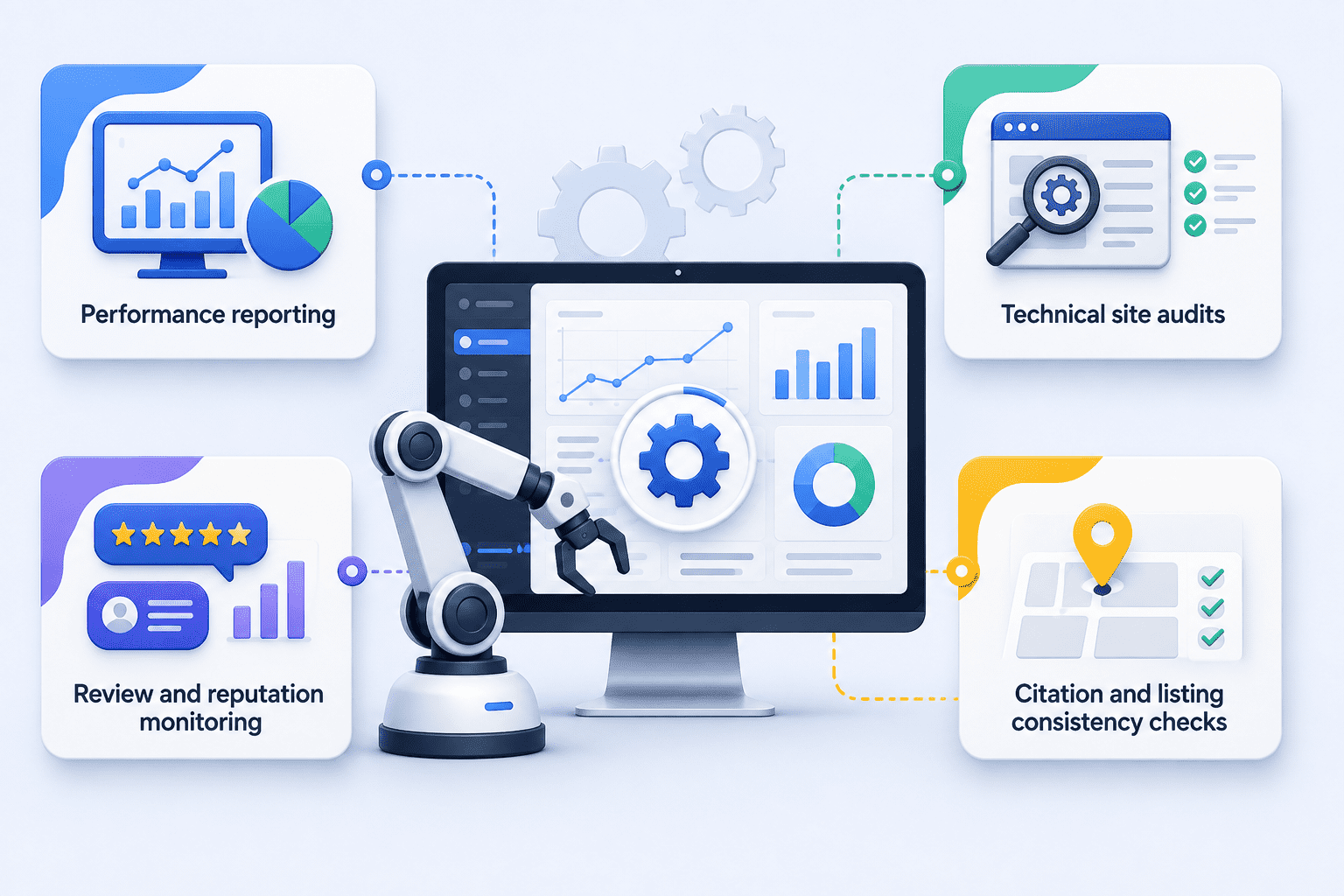
Automate performance reporting first. Set up dashboards that pull ranking, traffic, and call data automatically, replacing manual spreadsheet updates.
Automate technical site audits. Schedule recurring crawls that flag broken links, slow pages, and indexing errors before they hurt visibility.
Automate review and reputation monitoring. Trigger alerts for new reviews so responses go out quickly, protecting local trust signals.
Automate citation and listing consistency checks. Catch mismatched business information across directories before it confuses customers or search engines.
Content strategy and outreach stay manual longer than the tasks above, since judgment and local knowledge matter most there.
What Stays Manual Instead of Automated
Content creation, client communication, and strategic decisions need human judgment software can't replicate. Marketing works best when it's simplified enough that owners can focus on the handful of tasks that move the business, rather than micromanaging every automated report that comes through.
Repeatable Systems Beat One-Off Fixes
Teams get stronger long-term results from repeatable systems than from isolated shortcuts. A single technical fix fades quickly; a recurring audit process compounds value month after month, and that compounding is what automated SEO workflows are ultimately built on.
Time Savings From SEO Automation
Ten to twenty-five hours a week - that's the range marketing professionals report reclaiming after adopting SEO automation, per industry benchmarks (figure should be verified against a current source before this goes live). Owners juggling calls, quotes, and job sites rarely have that many spare hours for manual keyword tracking. Local service providers who automate ranking checks and reporting effectively free up entire workdays each month.
Business owners asking what SEO automation actually changes in daily operations will find the answer in reduced manual labor. Companies that adopt this approach report cutting manual optimization time by up to 60%. That freed-up time moves toward strategy, content quality, and conversion instead of repetitive busywork.
The discipline behind these gains, often called search engine optimization automation, replaces guesswork with measurable systems. Clear, trackable marketing shows an owner exactly how each effort contributes to growth, without extra hours of manual review to find out.
Where the Saved Time Actually Goes
Reclaimed hours typically shift toward higher-value work: refining service pages, responding to leads faster, and building local content that speaks to customers. Marketers spend less time compiling spreadsheets and more time interpreting what the numbers mean.
Savings vary by workflow, team size, and the tools deployed, though the benchmark range holds across most business types; a solo contractor sees different gains than an office managing several locations. Either way, the direction is the same: measurable time recovered every week, better spent serving customers than chasing rankings by hand.
Mistakes to Avoid When Automating SEO
The biggest mistake we see small business owners make is treating SEO automation as a replacement for strategy rather than a tool for executing one. Software can schedule reports and flag technical issues, but it can't decide what matters to a local plumbing company or a metal fabrication shop trying to win more calls. Growth stays the objective; automation only serves it when owners hold it accountable to results, not activity for its own sake.

A second common error is opacity. Owners who don't understand how their search engine optimization automation setup actually works lose the ability to catch problems early. Feedback loops matter here: visibility into what a system does and why is what lets someone correct course before rankings start to drift.
Fully Automated SEO Still Needs Human Oversight
Search engines run sophisticated AI systems processing billions of signals daily, which means automated outputs need human review before publishing. Skip that check, and a business risks compliance issues, poor brand alignment, or content that technically ranks but fails to convert local customers.
Owners looking to automate SEO responsibly should avoid these traps:
Letting software run unattended for months without a strategy review.
Failing to ask why a given automation exists before adopting it.
Measuring only tasks completed instead of leads, calls, and revenue generated.
Done right, SEO automation stops being a mystery. It's a growth engine that still needs a human hand on the wheel.
Conclusion
SEO automation changes how small businesses manage their online presence by clearing out repetitive tasks and freeing the team to focus on strategy and growth. Streamlining keyword tracking, content optimization, and performance monitoring delivers more consistent results with less manual effort behind them. Businesses that adopt these tools tend to hold a real edge in local search, and that edge shows up as more qualified customers, not just better-looking reports. Applied well, SEO automation pays for itself in both time and revenue.
FAQ
What is SEO automation?
SEO automation is the use of software and AI workflows to handle repetitive search optimization tasks, like keyword research, content audits, and performance reporting, without manual effort.
How much time does SEO automation save?
Marketing professionals report saving roughly 10 to 25 hours a week using automated SEO tools, with some businesses cutting manual optimization time by up to 60%.
Does SEO automation replace the need for a strategist?
No, automation handles repetitive tasks, but a marketer or agency partner still interprets the data, sets priorities, and adjusts direction as conditions change.
What SEO tasks should be automated first?
Performance reporting and technical site audits are typically the safest starting points, since they're high-effort, low-judgment tasks with a clear baseline to measure against.
Is it safe to run automated SEO without human oversight?
No, automated outputs still need human review before publishing to avoid compliance issues, brand misalignment, or content that ranks but doesn't convert.