What Is Offline SEO and How Can It Help Your Business?
Offline SEO includes real-world actions such as reviews, local sponsorships, press mentions, and word-of-mouth referrals that build a business's reputation outside its website but still affect how well that website ranks in local searches. Google regards these trust signals as evidence that the business is genuine, active, and worth recommending. For a service company operating in a highly competitive metropolitan area, offline SEO often makes the difference between appearing on page one and page three.
Key Takeaways
The kind of SEO that is carried out off-site, such as through reviews, sponsorships, press coverage, and referrals, has an impact on search rankings.
It is also referred to as off-page SEO and complements on-site efforts such as keyword optimization and page structure, rather than replacing them.
Reviews are by far the most important offline signal since, according to BrightLocal's 2026 research, 97% of consumers read reviews before deciding on a local business.
Putting it into action requires a systematic approach; it involves Google Business Profile, reviews, citations, sponsorships, and tracking, not just a single effort.
The BuildUp Agency provides both offline and online SEO as a unified system for home service and fabrication businesses in Utah.
What Offline SEO Actually Means
Offline SEO refers to all the actions that enhance a company's credibility in the real world, thereby having an eventual effect on its search visibility. A metal fabrication business gains this kind of credibility through customer reviews, sponsoring local events, receiving media mentions, and the level of name recognition that causes a business to be recommended to a prospective customer before they even open Google.
It is also referred to as off-page SEO, consisting of techniques that improve a site's ranking without altering a single line of code on the site. Some of the most long-lasting increases in ranking occur completely off the website.
How Offline Reputation Becomes an Online Ranking Signal
Search engines keep record of much more than the content on a webpage. A business that is regularly featured in its community, whether through sponsorships, press coverage, or continuous word-of-mouth, provides trust signals that are exactly the kind that Google's local algorithm has always been designed to reward, especially as a result of activity on the Google Business Profile and signals from reviews.
Reputation and rankings should not be considered as separate areas; a company's position within its own service area has a direct effect on how visible it is online. According to BrightLocal's 2026 Local Consumer Review Survey, 97% of consumers currently read reviews before deciding on a local business, and 41% state that they "always" read reviews when comparing different options, an increase from 29% the year before. Indeed, the majority of that company's future customer base makes their decision before even loading a single web page.
Online SEO vs. Offline SEO
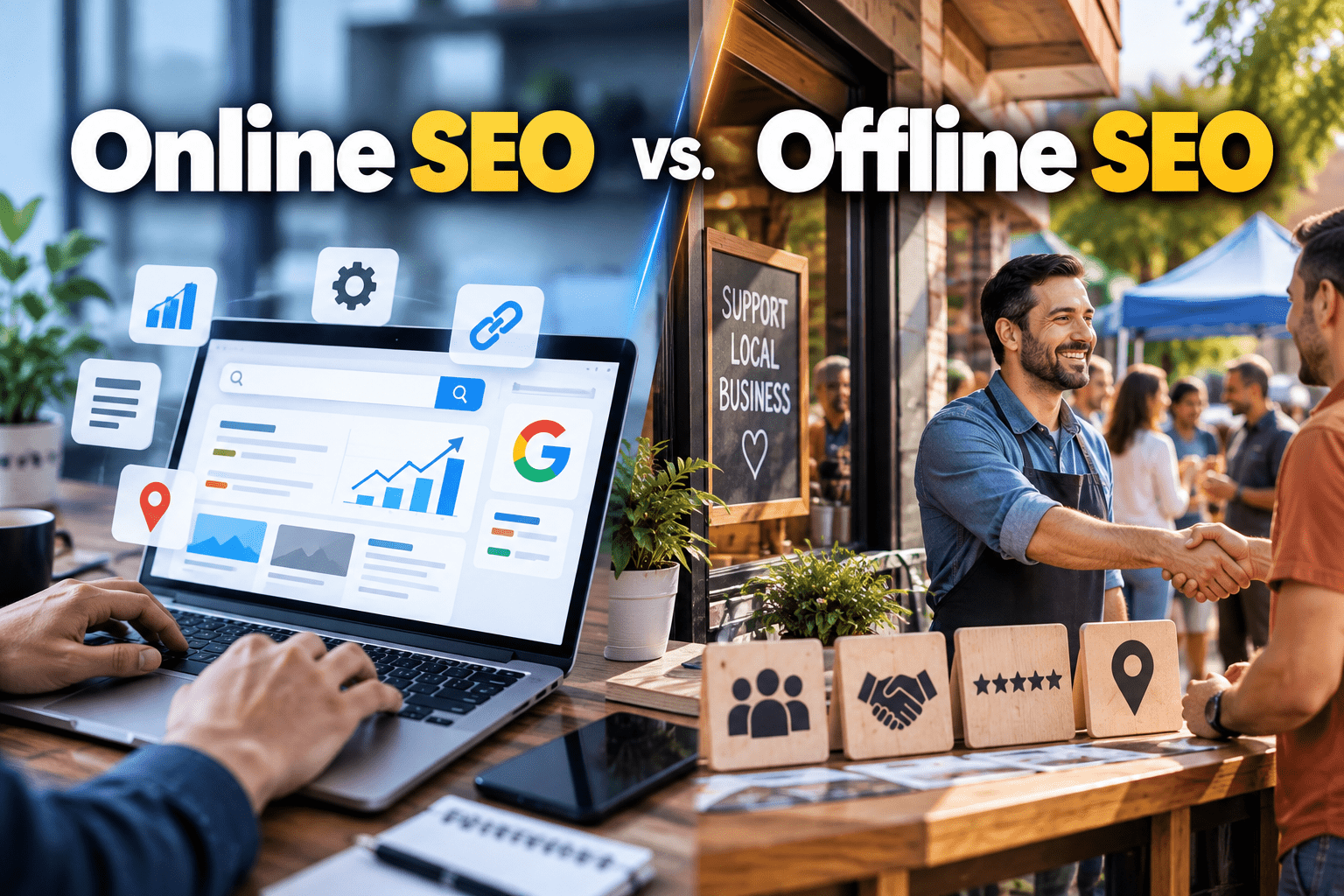
Primary Focus
Online SEO: Focuses on keywords, website structure, content, and technical SEO health.
Offline SEO: Focuses on reputation, community involvement, referrals, and local brand presence.
Signal Type
Online SEO: Relies on crawlable website content and other signals that search engines can access and evaluate.
Offline SEO: Builds real-world trust signals that can support a brand’s visibility and reputation in its local market.
Examples
Online SEO: Location-based landing pages, optimized service pages, internal linking, and technical improvements.
Offline SEO: Local event sponsorships, community involvement, customer referrals, and maintaining a steady flow of reviews.
What It Relates To
Online SEO: Primarily centers on the website and its content.
Offline SEO: Centers on the broader reputation and presence of the brand within its market.
In the past, online SEO paid rewards for repetition; this meant putting the same service-and-location phrase on a page multiple times. That approach is no longer the case, thanks to AI-powered search, which has sped up the change. Today's rankings are based on signals that a crawler cannot detect within a site's code, such as reviews, mentions by the community, sponsorships, and consistent local visibility.
Offline SEO Tactics That Actually Drive Calls
The SEO strategies that consistently yield results when working with clients in the fields of construction, fabrication, and welding are the dull and unimpressive ones, not the flashy ones. A homeowner who has already come across the company's name through a sponsored Little League team or because of a recommendation from a neighbour altogether omits the step of comparing shops.
A focused set of offline SEO techniques tends to separate businesses that grow from those that stall:
Local sponsorships and community involvement that build name recognition in a specific service area
Review generation systems tied to every completed job, not just the occasional happy customer
Consistent vehicle, signage, and print branding that reinforces the same identity across every touchpoint
Word-of-mouth referral tracking, so a business knows which relationships are actually generating leads
It is thanks to consistency in those channels that a smaller business can compete with and, in fact, overcome larger and better-funded rivals in the same market.
Offline SEO Tools That Turn Activity Into Data
It is tracking that distinguishes a genuine offline SEO strategy from mere guesswork. Any tool used for offline SEO measures activity that takes place away from the website; for example, a call-tracking number on a flyer, the referral source field on an estimate form, or a dashboard that records where the leads actually came from.
The tools that matter most for a local service business:
Call-tracking numbers assigned to specific print or sponsorship campaigns
Review monitoring and request automation tied to job completion
Referral-source tracking built into intake or estimate forms
Google Business Profile insights, cross-checked against actual booked jobs
Clear reporting should substitute assumptions with evidence, and it is that evidence which should determine next quarter's budget, not the tactic that seemed the busiest.
How to Implement Offline SEO
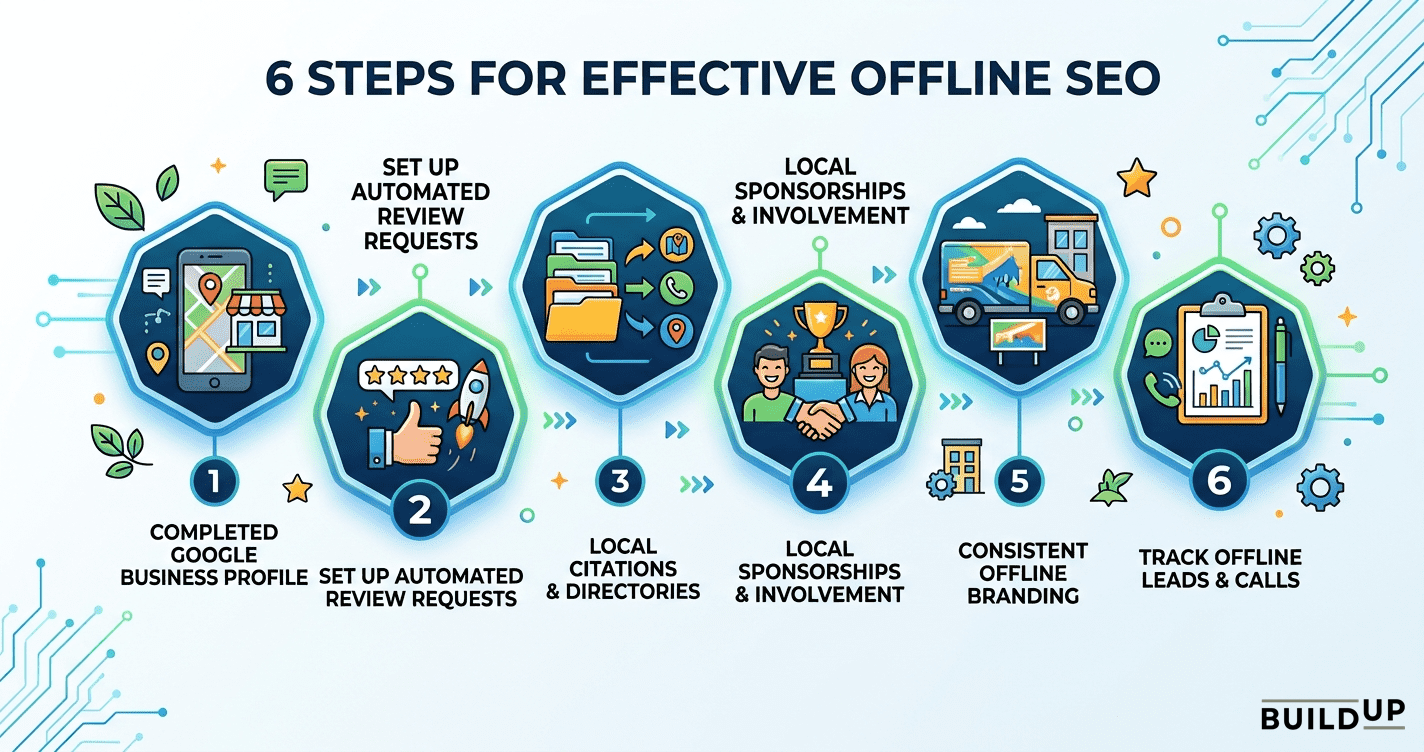
Offline SEO functions most effectively as a system that can be repeated, rather than as a single-time campaign. The following sequence proves itself in the majority of local service businesses:
Make and complete your Google Business Profile. Fill in all the fields such as the categories, service areas, opening hours, and photos, because an incomplete profile weakens all the other signals.
Develop the good habit of sending review requests. At the point when a job is completed, satisfaction is at its peak, so make sure you send the request and set up an automated follow-up to ensure it isn't left to memory.
Have your business included in local citations and directories; when your name, address, and phone number are the same in all the directories, this serves to confirm your legitimacy in Google's eyes.
Include one or two local sponsorships or get involved with the community. For example, by sponsoring a youth sports team, a trade association, or a local event, you will build the level of name recognition that appears in branded searches afterwards.
Make sure that the branding is consistent when used offline. The vehicle wraps, the signage, and the printed materials should use the same business name and service area language as that found on the website.
Keep all the information in dedicated number or form fields. If you don't keep records of it, you'll never be able to tell which offline activity is actually resulting in calls.
For each offline push, there should be an on-site update. In order for Google to have up-to-date content to link the signals to, new reviews and sponsorships require matching location pages or schema markup.
Building an Offline SEO Strategy With The BuildUp Agency
The BuildUp Agency is located in Draper, Utah, and operates directly within the home service and fabrication sectors that it serves. Its position in Draper has an impact on all of its recommendations, including decisions about whether sponsorships are worth a client's time and how a review campaign should be sequenced in relation to a homepage redesign.
In reality, the offline and online aspects of a campaign must be launched at the same time, not one after the other. If a welding shop increases the number of review requests without at the same time updating its location pages, it misses out on ranking improvements, since Google has no new information to crawl even though the trust signals rise. The owners concentrate on running their business, while The BuildUp Agency is responsible for linking the reputation efforts to what actually appears in search.
Frequently Asked Questions
What counts as offline SEO?
It is activity involving reputation building such as reviews, local sponsorships, press mentions, and referrals carried out away from a website but which still affects how search engines rank it.
Does offline SEO actually have an effect on Google's rankings?
Yes, it does. The local algorithm used by Google places great importance on review signals and on activity within the Google Business Profile, and BrightLocal's 2026 research showed that 97% of consumers read reviews before deciding on a local business.
What's the difference between offline SEO and off-page SEO?
The difference between offline SEO and off-page SEO is that off-page SEO is just the more technical term used for offline SEO activities that take place outside a website's own code.
What offline SEO tools should a small business begin with?
A call-tracking number, an automated system for requesting reviews that is linked to the completion of a job, and a straightforward referral source field on the estimate forms are the ones that meet most of the needs of a service business if it wants to start measuring its results.
How long before an offline SEO strategy yields results?
Reviews and reputation signals generally take between three and six months of continuous activity to build up, although call-tracking and referral data may show early successes within the first few weeks.