Landing Page Tips That Help Utah Businesses Get More Leads
The best landing page tips for Utah businesses include writing a clear, benefit-driven headline, using one focused call to action, simplifying forms, adding local trust signals, optimizing for mobile and page speed, and testing continuously. Businesses that apply these landing page best practices consistently see higher lead volume without increasing ad spend.
Key Takeaways:
A focused landing page converts significantly better than a general homepage because it eliminates competing choices.
Utah businesses running paid ads waste budget when traffic lands on pages that aren't built to convert.
Local trust signals matter more in service-based industries where customers are hiring a company to work on their property or vehicle.
Page speed and mobile usability directly affect both rankings and conversion rates.
Ongoing testing, not a one-time redesign, is what sustains lead generation over time.
Utah's business landscape is booming. From construction and metal fabrication companies along the Wasatch Front to transportation and vehicle leasing operators across the state, competition for local customers has never been tighter. Whether your traffic comes from Google Ads, organic search, or a referral link, the page a visitor lands on determines if they become a lead or bounce within seconds.
Below are 10 landing page tips for Utah businesses that consistently move the needle, along with the reasoning behind each one so you can apply them to your own site with confidence.
1. Lead With a Clear, Benefit-Driven Headline
The headline is the first thing a visitor reads, and it decides if they keep scrolling or leave. Utah businesses often make the mistake of leading with a company name or a generic slogan instead of a clear benefit.
A strong headline should:
State the core benefit in plain language ("Get a Fast, Free Quote on Your Next Fabrication Project")
Include a local reference when it strengthens relevance ("Serving Contractors Across the Wasatch Front")
Avoid industry jargon that a first-time visitor won't understand
Stay under roughly ten words so it's scannable on mobile
Pair the headline with a short subheadline that adds a second layer of context, such as the timeframe, service area, or a credibility marker like years in business or licensing.
2. Put Everything Important Above the Fold
Everything a visitor needs to decide "yes, this is relevant to me" should appear before they scroll: headline, subheadline, a supporting image or short video, and the primary call to action button. If a visitor has to hunt for what your business does or how to contact you, most will leave rather than dig deeper.
3. Use One Primary Call to Action
Multiple competing buttons ("Call Now," "Get a Quote," "Learn More") split attention and lower conversions. Pick one action and repeat it, ideally once near the top of the page and again at the bottom for visitors who scroll through everything before deciding.
4. Simplify the Lead Form
Every additional field reduces completions. Ask only for what's needed to follow up: name, phone number, and a brief project description. If you need more detail later, gather it during the follow-up call instead of upfront on the page.
5. Add Local Trust Signals

Utah service area maps, local phone numbers, licensing and bonding information, and reviews from nearby customers all reduce hesitation. Customers hiring a contractor, fabricator, or transportation company want proof that the business is established and familiar with the local area before they hand over contact information.
This matters more in Utah's trade and service industries than in many other markets, because the purchase decision often involves letting a crew onto a job site or handing over a vehicle. A visible business license number, a local address, and even a mention of specific Utah counties or cities served can be the difference between a visitor who fills out the form and one who moves on to a competitor's site instead.
6. Show Proof, Not Just Claims
Visual proof builds confidence quickly. Include:
Photos of completed work, equipment, or the team
Specific numbers where possible, such as years in business, projects completed, or service radius
Testimonials or reviews tied to real, nearby customers
Generic stock photography and vague claims of quality do less to convert a skeptical visitor than a handful of real project photos and a specific number.
7. Match the Page Message to the Traffic Source
A visitor clicking a "metal fabrication Utah" ad should land on a page about metal fabrication, not a generic homepage. Create separate landing pages for distinct services or service areas rather than one page trying to cover everything, and echo the exact language used in the ad or search result in the page headline.
8. Optimize for Mobile First
A large share of local searches in Utah, especially for services like welding, construction, and vehicle leasing, happen on mobile devices. If a landing page requires pinching to zoom, has buttons too small to tap accurately, or takes more than a few seconds to load, most visitors leave before ever seeing the offer. Mobile-first design should be the starting point for layout decisions, not a secondary check after the desktop version is finished.
Practical steps that make the biggest difference on mobile include compressing hero images, using a click-to-call phone number instead of requiring a form for urgent requests, and keeping the primary call to action visible without requiring a scroll. Google also uses mobile page experience as part of how it evaluates and ranks pages, so mobile optimization supports visibility as well as conversions.
9. Strengthen the Connection Between Local SEO and Your Landing Page
Landing page optimization and local SEO reinforce each other. A page built around a specific service and Utah location, like "Concrete Contractors in Salt Lake County," tends to rank better for that search term and converts better once visitors arrive, because the messaging matches what they searched for.
To connect the two effectively:
Include the city, county, or region naturally in the headline, subheadline, and body copy
Add schema markup so search engines and AI tools can accurately identify your business type, service area, and offerings
Keep contact information (name, address, phone) consistent with your Google Business Profile
This alignment also helps with AI-based search tools, which tend to pull direct, structured answers from pages that clearly state what a business does and where it operates. A landing page that opens with a plain-language statement of the service, the location, and who it's for gives both traditional search engines and AI Overviews a clear, quotable answer to work with, rather than forcing them to infer intent from vague marketing copy.
10. Test and Update the Page on a Regular Cadence
Landing pages aren't a "set it and forget it" asset. Visitor behavior, ad platforms, and competitor pages all change over time, so a page that converts well today may need adjustment in six months. A reasonable cadence for most Utah small and mid-sized businesses:
Review analytics monthly to spot drop-off points in the form or scroll depth
Run A/B tests on headlines, call-to-action wording, or hero images quarterly
Refresh photos, project examples, and testimonials at least twice a year
Audit page speed and mobile usability whenever the site or hosting changes
Even small, incremental tests, like changing a button color or shortening a form, can produce a measurable difference in lead volume when tracked consistently.
Final Thoughts
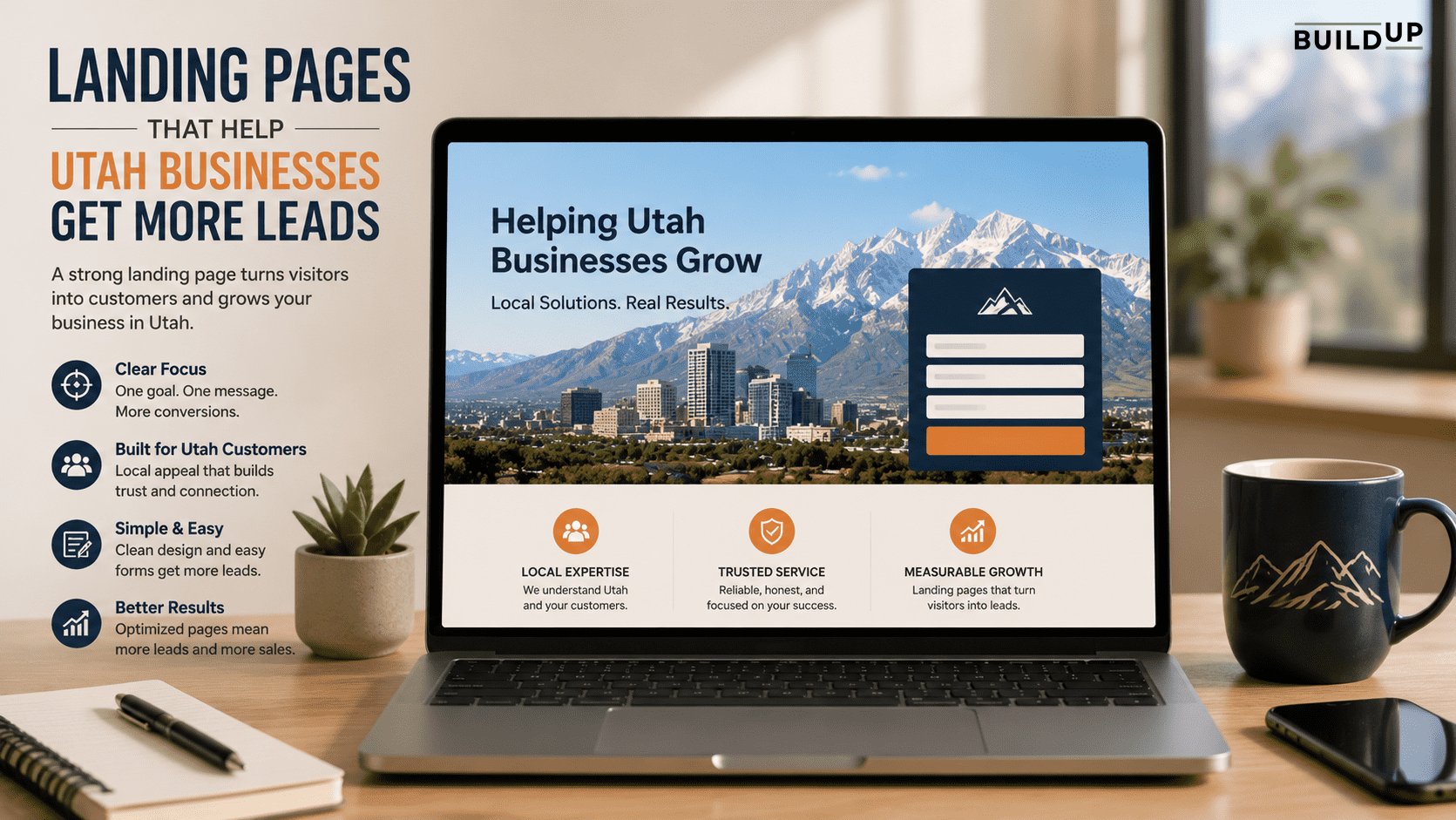
Building a landing page that consistently generates leads isn't about one big redesign. It's the combination of a clear headline, a focused structure, local trust signals, mobile-first design, and ongoing conversion rate optimization. Utah businesses that treat their landing pages as evolving assets, rather than static web pages, tend to see steadier lead flow and a better return on their marketing spend over time.
If your current landing pages aren't converting the way they should, start with the fundamentals covered here: one clear offer, one call to action, and a structure that matches how your visitors actually search and browse.
Frequently Asked Questions
What is the most important element of a landing page for lead generation?
The call to action is the most important element, since it directly determines if a visitor converts. It should be clear, repeated at least twice on the page, and free of competing options that might distract the visitor.
How long should a landing page be for a Utah service business?
Length depends on the complexity of the offer, but most effective landing pages run long enough to cover the service, build trust, and answer common objections, typically 400 to 800 words. The key is relevance and clarity, not hitting a specific word count.
Do landing pages need to be mobile-optimized?
Yes. A large portion of local search traffic in Utah comes from mobile devices, and a page that loads slowly or displays poorly on a phone will lose visitors before they see the offer. Mobile-first design should guide layout decisions from the start.
How is a landing page different from a homepage?
A homepage typically serves multiple purposes and links to many parts of a website, while a landing page is built around a single offer and a single call to action. This focus is why landing pages usually convert at higher rates than general homepages for the same traffic.
How often should a Utah business update its landing pages?
Most businesses benefit from reviewing analytics monthly and testing headlines, calls to action, or images on a quarterly basis. Photos, testimonials, and service details should be refreshed at least twice a year to stay current.