
How Google Reviews Help Fabrication Shops Win More Jobs
Google reviews help fabrication shops rank higher in local search, build trust with contractors and project managers, and generate leads without paid advertising. Shops with 25+ reviews at 4.3 stars or above consistently win more bids. Asking at job completion and responding to every review are the two highest-impact habits.
Key Takeaways
Google reviews are a core local SEO ranking signal; volume, rating, and recency all count
79% of buyers trust online reviews as much as personal referrals
70% of customers will leave a review if asked directly at the job close
Responding to reviews (positive and negative) builds trust and adds keyword signals for local search
Shops with 25–50 reviews at 4.3+ stars typically outrank competitors in most local markets
Repurpose reviews in proposals, your website, and social media to extend their value beyond Google
Treat reputation management as an ongoing process, not a one-time campaign
If you run a metal fabrication shop, custom welding business, or structural steel operation, you already know that your reputation does most of the selling. Word of mouth has always driven this industry, but today, that word of mouth lives on Google. Shops that actively collect and manage Google reviews for fabrication shops are winning more bids, ranking higher in local search, and building the kind of credibility that converts a cold visitor into a paying customer.
This guide covers exactly how Google reviews impact your shop's visibility, trust, and job pipeline, and what you can do right now to make them work harder for you.
Why Google Reviews Matter More Than Ever for Fabrication Shops
Fabrication is a relationship-driven business, but most new client relationships now start with a search. When a project manager, general contractor, or procurement officer types "fabrication shop near me" or "custom metal fabricator [city]," Google's local algorithm decides who shows up, and reviews are among the strongest ranking signals it uses.
According to recent consumer research, 79% of people trust online reviews as much as personal recommendations. For a fabrication shop trying to differentiate itself from competitors, a strong Google Business Profile with consistent five-star reviews is one of the most cost-effective marketing assets you can build.
Unlike paid ads that disappear the moment you stop spending, a solid base of authentic customer reviews keeps generating leads around the clock. That's the compounding value of online reputation management for fabrication businesses.
How Google Reviews Directly Impact Local Search Rankings
Google's local search algorithm, the one that determines who appears in the "map pack" at the top of results, weighs three primary signals: relevance, proximity, and prominence. Reviews are a core part of prominence.
Specifically, Google looks at:
Review volume — How many reviews your shop has compared to competitors
Average star rating — Shops with 4.0 stars or higher consistently attract more clicks
Review recency — Fresh reviews signal an active, trustworthy business
Review content — Keywords in review text (e.g., "custom steel fabrication," "structural welding") help Google understand what your shop does
Shops that implement structured data markup (schema.org/LocalBusiness) can also surface star ratings directly in search results as rich snippets, increasing click-through rates even before a prospect visits your website.
The practical takeaway: a fabrication shop with 40 reviews at 4.6 stars will consistently outrank a competitor with 8 reviews at 5.0 stars in most local markets.
Building Customer Trust in a High-Stakes Industry

Fabrication clients aren't buying a $15 product on impulse. They're committing budgets, timelines, and project quality to a shop they need to trust. Google reviews serve as the digital equivalent of a reference check.
When a potential customer reads that your shop "delivered structural components two weeks ahead of schedule" or "matched exact specs on a custom architectural piece," that specificity is far more persuasive than any marketing copy you could write yourself. These are authentic trust signals for fabrication businesses, the kind that close deals.
Responding to reviews amplifies this effect. When you reply professionally to both positive feedback and the occasional complaint, you demonstrate accountability. Prospects aren't just reading the reviews; they're watching how you handle them.
Proven Strategies to Collect More Google Reviews
Most satisfied customers won't leave a review unless you ask, but 70% will if you do. That means the biggest opportunity for most fabrication shops isn't the quality of their work; it's the absence of a system to capture feedback after a job is done.
Here's what works:
Ask at job completion, not months later. The best time to request a review is when the customer is still feeling good about the finished product, right at delivery or final sign-off. A brief, genuine ask ("We'd really appreciate it if you left us a Google review, it helps other contractors find us") goes a long way.
Send a direct link. Don't make customers hunt for your profile. Generate your Google review link through Google Business Profile and include it in your follow-up email or text. Removing friction dramatically increases follow-through.
Make it part of your post-job workflow. Build the review request into your standard job-close process, whether that's an automated follow-up email, a text message from your project manager, or a card left with the invoice. Consistency matters more than any single clever tactic.
Train customer-facing staff. Estimators, project managers, and delivery drivers all have moments of genuine customer connection. Give them language to use and make the ask a normal part of closing out a project.
One fabrication shop that implemented a structured review request process saw a 25% increase in inbound inquiries within three months without changing its advertising spend.
How to Respond to Reviews (And Why It Matters for SEO)
Responding to every review, positive and negative, is one of the most underutilized tools in fabrication shop marketing. Here's why it matters:
For positive reviews: A brief, specific response shows you read the feedback and value the relationship. Including a service keyword naturally ("Thanks for trusting us with your structural steel package. Precision fit-up is something we take seriously") reinforces your relevance signals for local SEO.
For negative reviews: Respond professionally, acknowledge the concern, and offer to resolve it offline. A thoughtful response to a complaint often impresses prospective customers more than perfect reviews it shows you stand behind your work. Never be defensive or dismissive in public responses.
For local SEO: Google indexes your review responses. Weaving in relevant terms like "custom metal fabrication," "precision welding shop," or "structural steel contractor" naturally within responses contributes to your overall keyword footprint in local search.
Turning Reviews Into a Full-Funnel Marketing Asset
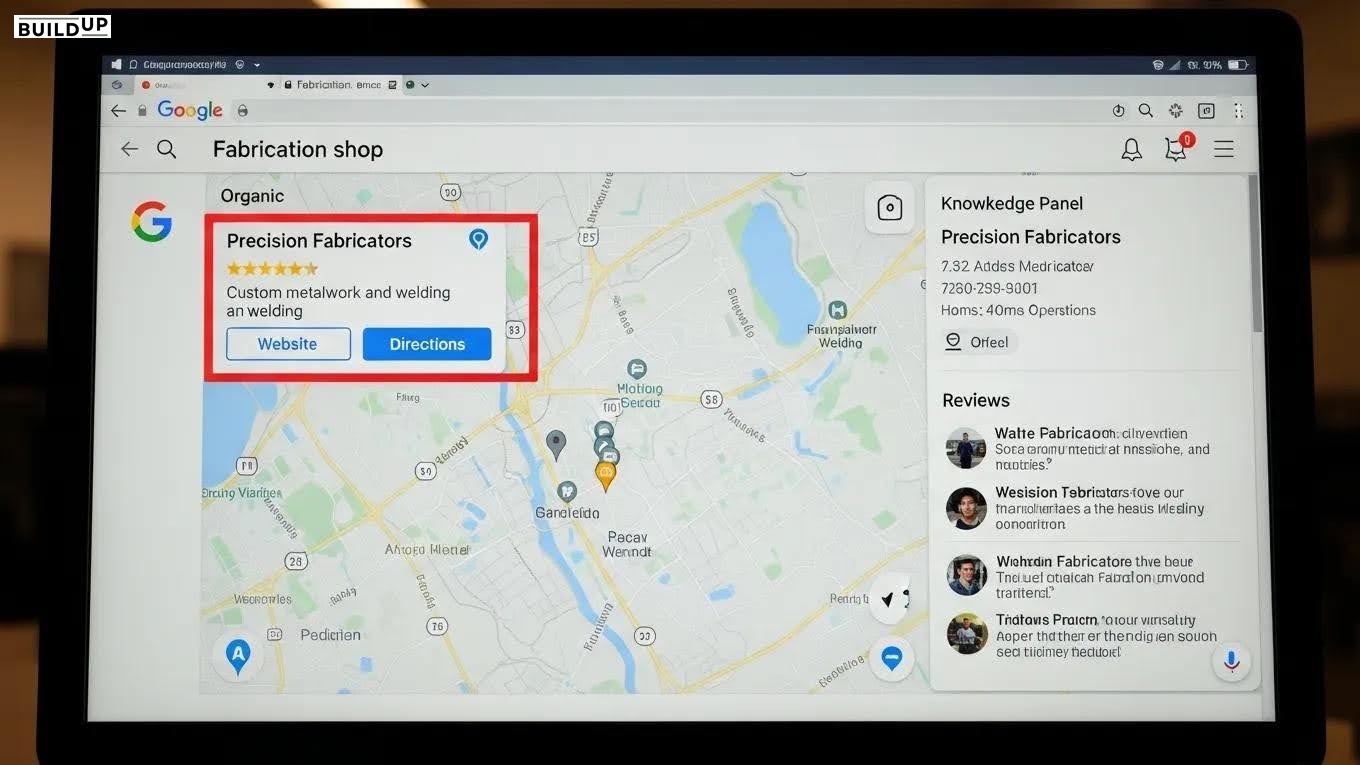
Google reviews don't have to live only on Google. Shops that repurpose customer feedback across marketing channels see compounding returns:
Your website: Add a testimonials section or embed your Google reviews widget on your homepage and services pages. Third-party validation from real customers outperforms any self-written copy for conversion.
Proposals and quotes: Including two or three relevant customer testimonials in your bid documentation adds credibility at a critical decision moment.
Social media: Share positive reviews as posts on LinkedIn or Facebook, especially reviews that mention specific capabilities (CNC plasma cutting, TIG welding, on-site installation, etc.). This reinforces your positioning to followers who aren't yet customers.
Google Business Profile posts: Regularly updating your profile with photos, project highlights, and responses keeps your listing active and signals to Google that your business is up to date and engaged.
Monitoring Your Online Reputation Over Time
A one-time push to collect reviews isn't enough. Fabrication shops that consistently outperform competitors treat reputation management as an ongoing operation, not a campaign.
Tools worth using:
Google Business Profile dashboard — Free, essential. Monitor new reviews, respond, and track profile views and search queries.
ReviewTrackers — Aggregates reviews across platforms and provides sentiment analysis, useful if your shop also appears on Yelp, Houzz, or industry directories.
Google Alerts — Set up alerts for your shop name to catch any mentions outside of review platforms.
Review your profile monthly at a minimum. Look at which search queries are driving profile views, and consider whether your review content and responses are reinforcing those terms.
A 2026 study analyzing 251 small business owners found that active online reputation management practices, particularly customer-centric engagement and consistent response behavior, directly correlate with improved business performance.
Frequently Asked Questions
1. How many Google reviews does a fabrication shop need to rank well locally?
It varies by market, but most mid-size markets see strong results with 25–50 reviews at 4.3 stars or above. Consistent volume and recency matter as much as total count.
2. Can I ask customers to leave a Google review?
Yes. Google explicitly permits asking customers for reviews. You cannot offer incentives or write reviews on their behalf, but a straightforward ask is both allowed and effective.
3. How do I respond to a negative review about my fabrication shop?
Reply promptly, stay professional, acknowledge the issue without admitting fault, and invite the customer to contact you directly to resolve it. Avoid arguments in the public thread.
4. Do keywords in Google reviews help with local SEO?
Yes. When customers naturally mention services like "structural steel fabrication" or "custom aluminum parts" in their reviews, those terms contribute to your relevance signals for related search queries.
5. How often should I be actively collecting new reviews?
Ongoing, make it part of your standard job-close process. Aim for at least two to four new reviews per month to maintain recency signals and keep outpacing competitors.